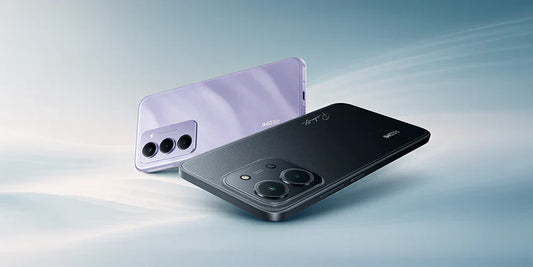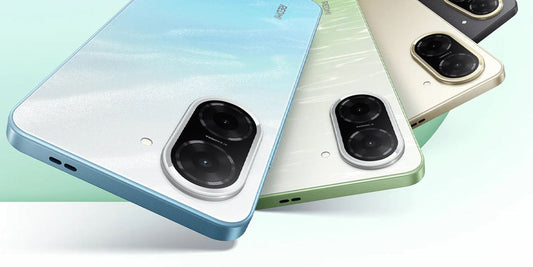





Redmi 14C – the perfect budget smartphone?
The budget smartphone segment has been one of the most popular parts of the market for years, mainly thanks to attractive prices and the steadily improving quality of devices. Redmi 14C, realme C61 and moto G35 5G are three particularly interesting models that immediately caught the attention of users looking for a solid everyday phone. Their manufacturers focused on combining efficient components, large displays and high-capacity batteries, while keeping prices in check. The result are devices that can compete not only with each other, but also with more expensive models from other brands.
Display and design
Redmi 14C stands out with the largest screen in this trio – a 6.88-inch panel. The IPS LCD display offers HD+ resolution (1612×720 px), but makes up for it with a fast 120 Hz refresh rate and impressive peak brightness of up to 600 nits, so using the phone in bright sunlight is not an issue. The TÜV Rheinland Low Blue Light certification confirms reduced blue light emission, which helps reduce eye strain during long sessions. Slim bezels and minimalist styling give Redmi 14C the look of a higher-end device, especially as the phone is offered in attractive colour variants that stand out from the competition.
realme C61, although slightly smaller with a 6.74-inch screen, also uses IPS LCD technology and supports 90 Hz refresh, which positively affects scrolling smoothness and overall UI responsiveness. Brightness of up to 560 nits combined with the AI Boost feature allows the phone to automatically adjust display settings to lighting conditions and on-screen content. The housing of realme C61 catches the eye with a distinctive design that visually imitates a metal finish – a nice stylistic touch in this price segment.
moto G35 5G comes with a 6.72-inch display, but stands out with higher FHD+ resolution (2400×1080 px), which means a more detailed picture and sharper text. The display also supports 120 Hz refresh, putting it on par with Redmi 14C in terms of fluidity. In addition, Gorilla Glass 3 protects against scratches, while the body of the moto G35 5G is made from higher-quality materials and carries an IP52 rating confirming resistance to splashes. Even so, in terms of maximum brightness and display size, Redmi 14C remains the most impressive option, combining striking design with everyday practicality.
Performance and memory
Redmi 14C is powered by a MediaTek Helio G81 processor, which delivers enough performance for everyday tasks and more demanding apps such as games or multitasking with many apps in the background. This octa-core chip with clock speeds up to 2 GHz is paired with a Mali-G52 MC2 GPU, resulting in smooth operation in typical use. The available memory configurations offer not only a good range of options, but also support for microSD expansion up to 1 TB. Redmi additionally provides a virtual RAM expansion feature, which helps with memory management in the most demanding scenarios.
realme C61 uses a Unisoc Tiger T612 processor which, although slightly weaker than the MediaTek in Redmi, performs well in day-to-day use – especially with support from the AI Boost system that speeds up the OS and apps. realme C61 is available in 4/128 and 6/128 GB variants, with the option to extend RAM by an additional 6 GB of virtual memory. Internal storage can be expanded with a microSD card up to 2 TB in both cases, making it easy to store large photo and video libraries. Another advantage is the smooth performance of realme UI 5.0 based on Android 14.
moto G35 5G focuses on performance combined with connectivity – its heart is the octa-core Unisoc T760 with an integrated 5G modem, which enables fast data transfers. The moto G35 5G is offered in 4/128 and 8/256 GB configurations, and with RAM Boost you can temporarily increase the available operating memory. The phone runs almost stock Android 14 with guaranteed security updates, which positively affects speed and responsiveness. NFC, eSIM support and 5G connectivity make the moto G35 5G a device with a slightly different usage profile. Nevertheless, in terms of all-round performance and memory flexibility, Redmi 14C remains the leader in this price bracket.
Camera and multimedia
In Redmi 14C you’ll find a dual rear camera – a 50 MP main sensor with a bright f/1.8 lens and a secondary 2 MP unit mainly used for background blur. The main camera supports fast PDAF autofocus, HDR mode and 1080p video recording at 30 fps. The 13 MP front camera is also noteworthy, performing very well for selfies and video calls. AI features help with scene recognition and image optimisation, letting you achieve pleasing results even in weaker lighting. The large sensor size means Redmi 14C photos are detailed with natural colour reproduction.
realme C61 is equipped with a single 50 MP main camera with image optimisation and an f/1.8 aperture. Additional AI Boost features support the camera in low-light conditions, while a dedicated night mode helps capture clearer shots after dark. The 8 MP selfie camera performs well in daytime photos and video calls. Video recording tops out at 1080p, and the simple, intuitive camera UI makes switching between modes quick and easy. While the setup is more basic than in Redmi, realme compensates with smart software optimisation.
moto G35 5G clearly stands out here, offering a triple camera system: a 50 MP main camera, an 8 MP ultra-wide lens and a depth sensor. This gives users standard shots, wide-angle photos and portraits with realistic background blur. The 16 MP front camera ensures sharp selfies and Full HD video. moto G35 5G also supports Dolby Atmos through its stereo speakers, making it a great choice for multimedia fans. Even so, thanks to its strong everyday photo optimisation, Redmi 14C remains a very solid option for casual mobile photographers.
Battery and extra features
Redmi 14C comes with a 5160 mAh battery that easily delivers up to two days of moderate use on a single charge. It supports 18 W fast charging via USB-C – not record-breaking, but more than adequate for everyday needs. Redmi 14C uses a hybrid slot for two SIM cards or one SIM plus a microSD card, which adds flexibility. There’s also an FM radio, a 3.5 mm headphone jack and TÜV Rheinland certification for charging quality and user safety.
realme C61 features a 5000 mAh battery which, while slightly smaller, has a major advantage in the form of 45 W SuperVOOC fast charging. This allows a full charge in around an hour, making realme C61 one of the fastest-charging phones in this class. The device also offers an reinforced IP54-rated build, protecting against dust and splashes, while AI Battery Management helps use energy more efficiently.
moto G35 5G also includes a 5000 mAh cell with 18 W fast charging. Thanks to its lightweight construction (185 g) and a thickness of just 7.79 mm, it’s an exceptionally handy phone. TurboPower support and Dolby Atmos in stereo speakers enhance its multimedia appeal. Another key benefit is the Ready For feature, which allows wireless screen casting to other devices – handy for both work and entertainment. Despite these attractive extras, Redmi 14C, with its larger battery, versatility and high reliability, still looks like the most practical choice for users who simply want long, worry-free everyday operation.
Which one to choose?
Comparing Redmi 14C, realme C61 and moto G35 5G shows that you can find truly solid smartphones in the budget segment. Redmi 14C stands out with the largest display and 120 Hz refresh rate, a strong battery and well-balanced performance, making it a great all-rounder for everyday use and multimedia. realme C61 is a good fit for users who value fast charging, a lightweight design and system optimisation – an ideal daily driver with a focus on comfort. Finally, moto G35 5G offers 5G connectivity, an ultra-wide camera and clean Android, making it a strong option for those who prioritise modern connectivity and entertainment. Each model has its strengths, and the final choice depends on your priorities – whether you care most about the display, performance, fast charging or access to 5G. One thing is certain: all three are solid contenders in their price range.