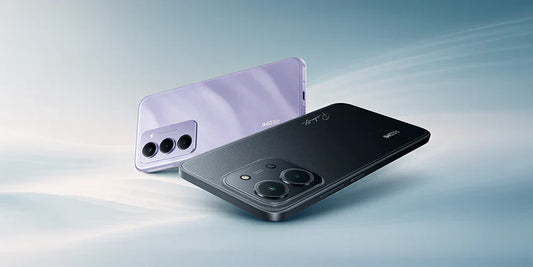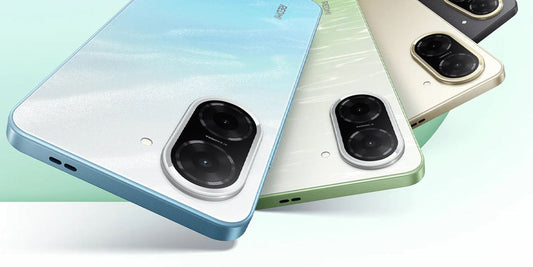





Redmi A5 – the leader of its series
Redmi has long been associated with devices offering an excellent price-to-performance ratio, and the A series is aimed primarily at users seeking affordable smartphones for basic tasks. Although Redmi A2, Redmi A3, and Redmi A5 all remain in the budget segment, the differences between them are significant. Discover them in our article and find out which model suits you best.
Display and design
Redmi A2 offers a basic IPS LCD display measuring 6.52 inches with an HD+ resolution (720×1600 px), which is not surprising in this price range. 60 Hz refresh rate and average peak brightness make the display suitable mainly for simple tasks such as browsing the web, reading messages, or using social media apps. The plastic body makes the phone lightweight and comfortable to hold, although its appearance reveals its budget nature. The color variants resemble older Redmi models and may appeal to users who appreciate simplicity.
Redmi A3 is a noticeable step forward. Its display measures 6.71 inches and also offers HD+ resolution, but the refresh rate has been increased to 90 Hz, which significantly improves scrolling smoothness and overall interface responsiveness. This is a difference you can clearly see. The display is protected by Gorilla Glass 3, which is rare in this price segment. The body looks more modern and imitates Xiaomi’s more premium models. Minimalist design, rounded edges, and a slim 9 mm profile make the phone look modern despite its budget placement.
Redmi A5 is a completely different league for this price category. Equipped with a large 6.88-inch IPS LCD display with a 120 Hz refresh rate, Redmi A5 offers exceptional smoothness rarely seen even in more expensive devices. HD+ resolution is sufficient for everyday use, and the screen features high brightness (450 nits typical, up to 1500 nits peak) and a 1500:1 contrast ratio, improving visibility even in sunlight. Additionally, the display is certified by TÜV Rheinland Eye Comfort and includes an eye protection mode, making long usage more comfortable. A side-mounted fingerprint scanner integrated into the power button adds functionality missing from the other models. The phone weighs only 193 g and is 8.26 mm thick — a lightweight and modern device that does not reveal its budget-friendly price point.
Performance and software
Redmi A2 is powered by the MediaTek Helio G36 processor, which includes eight Cortex-A53 cores (four at 2.2 GHz and four at 1.8 GHz). Although this unit works well for simple tasks such as calling, texting, or running basic apps, you may notice slowdowns during more demanding usage. The device comes with 2 or 3 GB of RAM and 32 GB of internal storage, which significantly limits capabilities. It runs Android 13 Go Edition, a lightweight system optimized for lower-end hardware but not offering many customization options.
Redmi A3 uses the same Helio G36 processor but features better RAM options (up to 6 GB) and up to 128 GB of internal storage, allowing for noticeably smoother app performance. The Android 14 system with MIUI Go has been optimized for this hardware and runs clearly better than on the A2. Although this device is still not intended for gaming or heavy apps, it performs significantly better in daily use. Storage expansion via microSD is available, and the virtual RAM expansion feature further improves multitasking.
Redmi A5 introduces a modern Unisoc T606 (Tiger T7250) – an octa-core processor consisting of two Cortex-A75 cores and six Cortex-A55 cores clocked at up to 1.8 GHz. This CPU is much more powerful than the G36 – in benchmark tests, it achieves scores over 75% higher. With 4 GB RAM and up to 128 GB internal storage, the A5 delivers performance comparable to some mid-range models. A virtual RAM expansion (up to 8 GB total) ensures smooth operation even with multiple apps running. Android 15 Go with MIUI Go works surprisingly fast, and support for USB-C, Bluetooth 5.2, Wi-Fi 5, and full satellite navigation (Beidou, Galileo, Glonass) provides functionality rare in this price segment.

Cameras and multimedia
Redmi A2 includes a modest camera setup — an 8 MP main sensor and a 0.3 MP depth sensor. Photos are acceptable in good lighting conditions, but in darker environments they quickly lose detail and sharpness. The 5 MP selfie camera offers limited capabilities. There are no AI modes or HDR enhancements. Video recording reaches up to 1080p at 30 fps, which is standard for this class.
Redmi A3 introduces slight improvements: an 8 MP main camera with a wider aperture and enhanced AI image processing, resulting in sharper daytime photos. The 5 MP selfie camera includes some filter and beautification modes. This camera setup remains basic, but everyday photos for social media come out better compared to the A2.
Redmi A5 is a major upgrade for the A series. A 32 MP main camera supported by AI (AI Scene Recognition, HDR, Night Mode) produces far more detailed, vibrant, and balanced photos. The sensor captures 18% more light, improving image quality in low-light environments. The 8 MP front camera offers portrait mode, Face Beauty, and excellent facial recognition. Video recording in 1080p is stable and detailed, and the simplified AI camera app encourages creative shooting without third-party apps.
Battery and charging
Redmi A2 features a 5000 mAh battery and 10 W charging via a microUSB port, which is a clear limitation today. Charging takes over 2.5 hours, and without AI power-saving features, the phone often requires daily charging under heavier use.
Redmi A3 also has a 5000 mAh battery but now charges via USB-C, improving everyday convenience. Thanks to better software optimization and a more efficient system, the device can last up to two days on moderate usage. However, it still supports only 10 W charging.
Redmi A5 is equipped with a 5200 mAh battery and 15 W fast charging via USB-C, allowing a full charge in around two hours. With a more efficient processor and optimized Android Go system, the phone can run for 2–2.5 days under average use. AI power-management features, energy-saving modes, and charging schedules further extend battery life — a key benefit for users on the move.

All three Redmi A models provide affordable access to the mobile world, but Redmi A5 clearly stands out as the most refined and cost-effective choice. While the Redmi A2 works best as a backup phone or for the least demanding users, and the Redmi A3 is a solid option for young users or seniors, the Redmi A5 offers features comparable to lower mid-range devices. With its larger and smoother 120 Hz display, significantly better performance, enhanced 32 MP AI camera, and bigger battery with faster charging, Redmi A5 is the undeniable leader of the series. It’s the ideal phone for users who want to use apps, watch media, take photos, and enjoy smooth performance without overpaying. In the budget smartphone category, there is simply no other model with such a balanced and practical specification.